









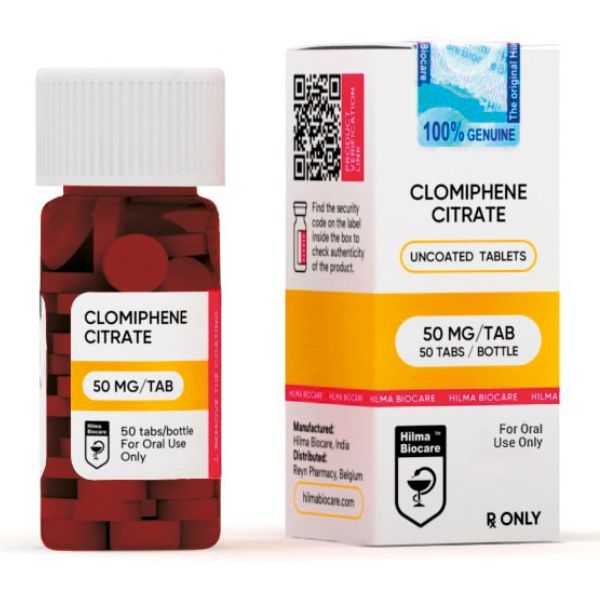

Clomiphene citrate Hilma Biocare 50 mg
Clomiphene citrate , also known as Clomid, is a selective estrogen receptor modulator (SERM). It works by stimulating the hormonal signals that control the natural production of testosterone.
Product features
| Characteristic | Product information |
|---|---|
| Active ingredient | Clomiphene citrate |
| Class | Selective estrogen receptor modulator (SERM) |
| Shape | Tablets to be taken orally |
| Dosage | 50 mg per tablet |
| Packaging | 50 tablets |
| Persistence | Variable depending on the isomers; zuclomifene sometimes remains detectable for more than a month. |
Action on LH, FSH and testosterone
Clomifene alters the feedback loop exerted by estrogen at the level of the hypothalamus and pituitary gland. The reduction of this signal promotes the release of GnRH, then LH and FSH.
- LH stimulates Leydig cells and testicular testosterone production.
- FSH supports the function of Sertoli cells and sperm production.
The response depends on the ability of the hormonal axis and the testicles to respond to this stimulation. Low testosterone accompanied by already elevated LH and FSH suggests testicular involvement, which requires further evaluation.
Role in post-cycle recovery
Following exposure to anabolic steroids, clomiphene is used to support the recovery of endogenous hormonal signals. The described context combines low testosterone with low or insufficiently elevated LH and FSH levels.
The timing of this treatment takes into account the elimination of suppressive agents, particularly long esters. Sustained recovery is confirmed after discontinuation of the SERM, when hormone concentrations remain appropriate without drug stimulation.
Male fertility and secondary hypogonadism
Clomifene is also used off-label in some men with secondary hypogonadism or fertility problems. The goal is to stimulate endogenous testosterone while maintaining pituitary signals involved in spermatogenesis.
When the goal is conception, monitoring includes a semen analysis: sperm concentration, motility, and morphology. Testosterone levels and fertility are measured separately.
Enclomifene and zuclomifene
Clomiphene citrate contains two isomers whose activity and duration of presence in the body differ:
| Isomer | General profile |
|---|---|
| Enclomiphene | Primarily anti-estrogenic contribution, with a shorter persistence. |
| Zuclomiphene | More pronounced estrogenic activity and prolonged persistence, sometimes exceeding one month. |
The most persistent component accumulates with repeated administrations. The effects and some side effects may therefore continue after the last tablet.
Clomifene, tamoxifen and HCG
Clomifene and tamoxifen belong to the SERM family. Clomifene is primarily known for stimulating LH and FSH; tamoxifen for its action on estrogen receptors in breast tissue and its role in hormonal recovery. Their dosages and safety profiles differ.
HCG acts at the testicular level by mimicking the action of LH. Clomifene stimulates signals upstream, at the pituitary level. Combining these drugs requires a defined objective and monitoring; the benefit of combining two SERMs should also be assessed on a case-by-case basis .
Dosages described in human studies
Male use is off-label. The regimens mentioned in the original information sheet include 25 mg daily, 25 mg every other day, or 50 mg daily , depending on the indication and monitoring. A post-cycle cohort mentioned in this information sheet used 25 mg daily after short-term exposure to anabolic steroids.
These data describe study settings. The choice of dose depends on hormonal status, tolerance, and the planned duration of use. Higher exposure increases the severity of visual disturbances and other adverse effects.
Splitting a 50 mg tablet requires a form and instructions that allow for precise division.
Biological monitoring and response to treatment
- Before taking: total and free testosterone, LH, FSH, estradiol, SHBG and prolactin when the context justifies it.
- During treatment: hormonal changes, mood, visual symptoms, liver parameters depending on the context and spermogram in case of fertility project.
- After stopping: retesting of testosterone, LH and FSH, taking into account the persistence of isomers and the initial assessment.
An increase in testosterone production provides more substrate for aromatization; therefore, estradiol levels can rise. The interpretation of the results considers all of these parameters.
Side effects and precautions
Side effects include headaches, nausea, hot flashes, fatigue, breast tenderness, irritability, mood swings, and emotional changes.
Blurred vision, flashes of light, spots, floaters, or afterimages: stop taking the medication and consult a doctor immediately. Some reported visual disturbances have persisted after discontinuation.
Clomifene is contraindicated in cases of liver disease, a history of liver dysfunction, or a previous severe reaction to the product. Uncontrolled thyroid or adrenal disease, as well as suspected pituitary dysfunction, require prior medical evaluation.
Storage and verification
- Store the tablets in their original packaging, at controlled room temperature, away from direct light, heat and moisture.
- Check the integrity of the packaging, the legibility of the label and the batch information; discard any product showing signs of tampering.
- The Hilma Biocare protection code allows authenticity to be verified via the brand’s verification system.
Health and usage information
This page provides educational product information to help you make informed choices. It is not a substitute for medical advice. If you have a health condition or questions about dosage, consult a sports medicine physician or other healthcare professional.


Reviews
There are no reviews yet.